
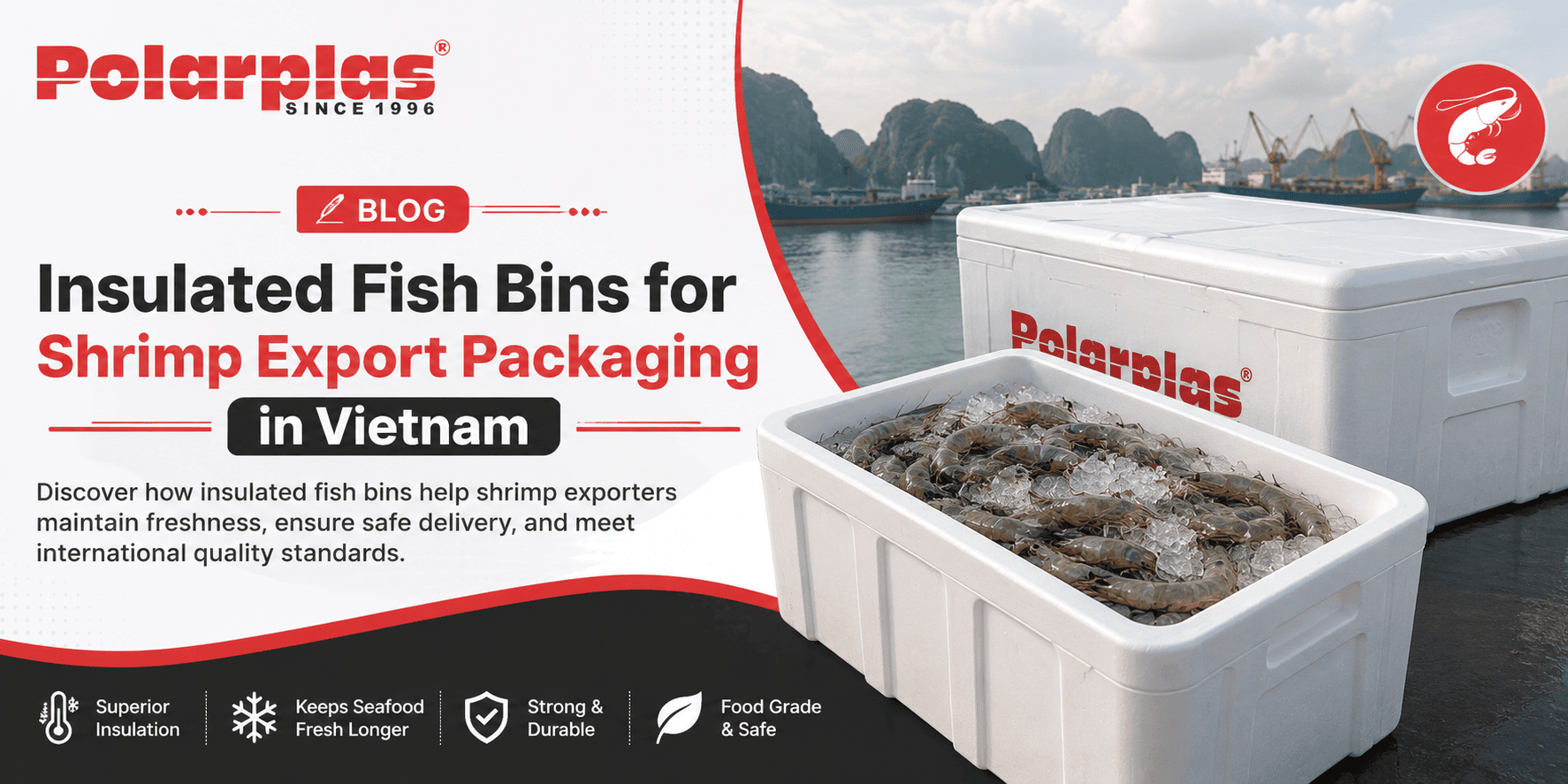
Insulated Fish Bins for Shrimp Export Packaging in Vietnam
Insulated Fish Bins- Vietnam’s shrimp industry crossed USD 4.6 billion in exports last year. That’s nearly 19% growth year-on-year. The country now targets USD 11.5 billion in total seafood exports this year. Every container of shrimp leaving Ca Mau, Bac Lieu, or Soc Trang faces one quiet test before it reaches buyers in the US, EU, China, or Japan. That test is packaging quality.
This is where insulated fish bins for shrimp export packaging in Vietnam matter most. Vietnam’s aquaculture sector is scaling up fast under the government’s National Aquaculture Strategy. Exporters now face growing pressure to meet HACCP, GlobalGAP, and ASC cold chain standards. A single failed shipment doesn’t just cost one order. It can flag an exporter for stricter inspection on every future shipment to that market. That risk outweighs the price of better packaging by a wide margin. Polarplas builds export-grade insulated fish bins for exactly this kind of high-volume, long-distance seafood logistics. This guide covers why the right container matters, what to look for, and how it fits into Vietnam’s shrimp export chain.

Vietnam’s Shrimp Export Boom, and the Packaging Gap Behind It
Vietnam has quietly become one of the top three shrimp suppliers to the world’s largest seafood markets. It now competes directly with Ecuador and India. Shrimp exports alone reached USD 4.6 billion last year. Early figures this year show double-digit growth again. Pangasius, squid, octopus, and bivalve mollusks show similar upward trends. This means the entire cold chain faces more pressure than ever. Ponds in the Mekong Delta feed container ships leaving Ho Chi Minh City. Every stage in between needs to move larger volumes without losing freshness.
Packaging often gets overlooked in this growth story. Exporters invest heavily in processing plants, certifications, and logistics contracts. But many still rely on generic plastic crates or thin single-wall boxes. These were never built for Vietnam’s climate. Ambient temperatures here regularly cross 32-35°C. A container with weak insulation loses its ice retention within a few hours. That happens long before the shrimp even leaves the province. This gap between processing quality and packaging quality is exactly where insulated fish bins change an exporter’s bottom line.
Why Vietnam’s Shrimp Export Industry Needs Better Insulated Packaging
Shrimp is one of the most temperature-sensitive seafood products in global trade. It starts degrading within hours of harvest without consistent cold temperature. Any fluctuation during transport can trigger quality downgrades. In the worst case, importing countries reject the shipment outright.
Vietnam’s shrimp exporters face a few specific challenges:
- Long transport distances from Mekong Delta farms to processing hubs and ports
- Strict cold chain compliance requirements from the US, EU, and China
- Tropical ambient temperatures that speed up spoilage when insulation is weak
- Rising shipment volumes that demand stackable, space-efficient containers
- Growing scrutiny on packaging, labeling, and traceability under new export rules
- Seasonal peak loads during harvest months, when plants need extra containers fast
Ordinary plastic crates can’t hold ice retention through multi-hour transport in this climate. Thin-walled boxes fail even faster. That’s why more processors now switch to double-wall insulated fish bins built for tropical cold chain conditions. Packaging stops being an afterthought once exporters see this shift pay off.
What Makes Polarplas Insulated Fish Bins Ideal for Shrimp Export
Polarplas builds insulated fish bins using rotational and injection moulding technology. Each bin gets double-wall insulation through PE or PU foaming. This construction performs in extreme conditions. It handles sub-zero cold storage and hot tropical climates like Vietnam’s with equal ease. The walls resist warping and cracking, even after repeated use.
- Temperature performance: withstands -50°C to +100°C, keeping ice retention stable during long hauls
- Food-grade material: made from virgin LLDPE/HDPE, safe for direct contact with shrimp and seafood
- UV-stabilised build: resists degradation from prolonged sun exposure during outdoor loading and transport
- Stackable design: maximizes container and warehouse space during export shipping
- Heavy-duty, seamless construction: handles repeated loading, forklift handling, and rough transport conditions
- Recyclable material: supports sustainability goals increasingly demanded by EU and US buyers
- Drain facility options: available with or without drainage, useful during ice-melt management at processing plants
Each feature solves a real problem exporters run into. Containers often sit outdoors at loading docks for hours under direct sun. UV resistance protects them there. Ocean freight costs depend on volume, so stackability cuts the number of containers per shipment. A bin that cracks mid-transit damages more than its own shipment. It can ruin an entire pallet load around it. That’s why seamless, heavy-duty construction matters so much here.

Sizes and Capacity Options for Shrimp Exporters
Shrimp export operations range from small processing units to large integrated farms. A single tub size rarely fits every stage. Polarplas offers insulated fish tubs and bins across a wide capacity range. Smaller 70-100 litre bins suit farm-to-plant transport. Large 1000-1400 litre containers, like the 1010L (DX-335) insulated container, handle bulk export shipments.
Smaller containers in the 70-150 litre range work best at the farm-collection stage. Shrimp gets gathered from multiple ponds here and needs to move fast to a nearby processing facility. Mid-range containers between 250-650 litres suit processing plants, where sorted and graded shrimp waits before packing. The larger 800-1400 litre containers handle final bulk transport to ports. Fewer, larger containers here cut handling time and labor costs during loading onto refrigerated trucks or reefer containers.
Some processing lines need round-shaped containers instead. Polarplas offers insulated round tubs with the same insulation performance in a different form factor. Many plants prefer round tubs at the washing and grading stage. Curved internal corners rinse out completely between batches. This lowers the risk of cross-contamination.

Supporting Cold Chain Compliance for Vietnam’s Seafood Exporters
Buyers in the US, EU, China, South Korea, and Japan increasingly demand documented cold chain traceability. Polarplas insulated bins support this in a few practical ways:
- In-mould branding and serial numbering for batch traceability from farm to export
- Barcode, QR code, and RFID tracking options that integrate with modern logistics and inventory systems
- Internal and external test certification on request, supporting HACCP and GlobalGAP documentation
- Custom branding (logos, company marks) for exporters shipping under their own private label
These features matter more in Vietnam right now. Bodies like VASEP push exporters toward formal, fully-traceable supply chains. Competition from Ecuador and India keeps intensifying in markets like China and the US. China has tightened rules on quarantine, packaging, and labeling for imported seafood. Exporters who can’t show a clean, documented chain of custody risk delays or rejection at the border. RFID and QR-code enabled containers make this easier. An auditor can trace where a batch has been and how it was handled, without relying on paper records that get lost or mismatched.
Serving Vietnam’s Key Shrimp Export Hubs
Vietnam’s shrimp aquaculture concentrates in the Mekong Delta region. Insulated fish bins see the highest demand across:
- Ca Mau – Vietnam’s largest shrimp farming province, home to thousands of small and mid-sized farms feeding regional processing plants
- Bac Lieu – major hub for intensive shrimp aquaculture, with a growing number of export-certified processing facilities
- Soc Trang – strong processing and export infrastructure, particularly for black tiger and white-leg shrimp
- Can Tho – central Mekong Delta logistics and processing base, often the last major inland stop before goods head to port
- Ho Chi Minh City – primary port and export gateway for international shipping, where consolidated shipments get loaded for ocean freight
Polarplas ships insulated fish bins and containers to processors, cold storage operators, and export logistics companies across these regions. Coverage runs the full journey from farm to port. An exporter based in the Mekong Delta or coordinating logistics from Ho Chi Minh City can use the same container range for collection, processing, and final export. This simplifies procurement and cuts the number of suppliers an operation needs to manage.
Why Choose Polarplas for Shrimp Export Packaging
Polarplas is a sister concern of Seaplast (India) Private Limited. The company builds export-focused insulated containers to international durability and quality standards. Exporters running mixed cold chain operations also use Polarplas’ refrigeration products for on-site cold storage. Many pair these with hygienic pallets for safe warehouse and container loading. Exporters with non-standard size or branding needs can also order custom moulded products built to exact specifications.
Working with one manufacturer across bins, pallets, and refrigeration equipment has a practical advantage. Quality standards stay consistent. Exporters get a single point of contact for after-sales support, spare parts, or repeat orders during peak export season, when lead time matters more than usual.
Setting up or scaling a shrimp export operation in Vietnam? Get in touch with Polarplas to find the right insulated fish bin size and specification for your cold chain.
Frequently Asked Questions
What size insulated fish bin is best for shrimp export?
It depends on your stage in the supply chain. Smaller 70-150 litre bins suit farm-to-processing-plant transport. Mid-range 250-650 litre bins work well for in-plant grading and washing. 800-1400 litre containers fit bulk export shipments from processing plants to ports.
Can insulated fish bins handle Vietnam’s tropical climate?
Yes. Polarplas insulated fish bins use UV-stabilised material and double-wall PE/PU foam insulation rated for -50°C to +100°C. This keeps ice retention stable even in high ambient heat.
Are Polarplas insulated fish bins food-grade safe for shrimp?
Yes. They’re made from virgin LLDPE/HDPE material, safe for direct contact with fish, shrimp, and other seafood. This meets standard food-safety requirements.
Do these bins support export traceability requirements like HACCP or GlobalGAP?
Yes. The bins can carry in-mould serial numbering, barcodes, QR codes, or RFID tags. Internal and external test certificates are available on request to support compliance documentation.
Can the bins be customized with my company branding?
Yes. Polarplas offers in-mould embossing, engraving, screen printing, and post-moulded labelling. Exporters can add logos, batch numbers, or custom branding directly onto the containers.
Are these insulated fish bins reusable and recyclable?
Yes. They’re made from recyclable virgin material and built for repeated use across many transport cycles. This also supports the sustainability standards EU and US buyers increasingly expect.
